
Part 2: Producing Surplus, Extracting Value

LotBO Series: When Abandonment Becomes Extraction
Last Time: dual extraction in real time.
Today: where this architecture came from.
A Deliveroo rider works Friday evening to protect Saturday afternoon with her daughter. She declines orders that take her too far from home. The algorithm suspends her priority access. Five hours later: £52 earned, £45 parking fine, £12 fuel. The extra shift costs her £5 whilst three separate systems profit from her attempt to control her own time.
Why does monetising someone’s precarity require rhetoric that blames them for draining resources they’re actually generating?
Because contemporary racial capitalism doesn’t just exploit workers—it marks populations as economically obsolete, then captures value from their managed abandonment. The question isn’t whether you’re employed or unemployed, working or sanctioned.
The question is who owns the infrastructure that profits from you either way.
California, 1982: Four Surpluses, One Solution
Post-1970s deindustrialisation left California with problems requiring management. Ex-military bases and agricultural zones nobody wanted. Investment capital seeking returns in a stagnating economy. Workers displaced by factory closures, no longer needed for production. State bureaucracies losing purpose as welfare systems contracted.
California built 23 new prisons between 1982 and 2000. Prison population increased by 500%.
Crime rates didn’t drive this expansion—economic restructuring did. Prisons absorbed all four surpluses simultaneously: rural land repurposed as carceral infrastructure, capital finding investment opportunities in construction and operation, displaced workers becoming raw material for new accumulation strategy, state bureaucracies redirected from social support to population management.
Ruth Wilson Gilmore’s Golden Gulag documents what this reveals: incarceration as class management through racial coding.
The populations rendered obsolete by deindustrialisation—working-class communities in former manufacturing regions, predominantly Black and Latino—became revenue sources rather than costs. Not just warehoused but monetised through unpaid labour, fines extracted from families, markets created for private contractors, spatial isolation preventing collective organisation against their abandonment.
The genius lies in self-reinforcing logic. Criminalise poverty’s survival strategies—street vending, drug economies, property “crimes” born from desperation—then capture value from the resulting incarceration through court fees, commissary monopolies, phone call charges, unpaid labour. The economic abandonment that creates surplus populations generates the conditions for their profitable management.
But here’s the counterargument: hasn’t capital always rendered populations surplus?
Isn’t this just capitalism doing what it’s always done—displacing workers, extracting value through exploitation? What’s historically specific?
Two things.
First, the dual capture. Traditional capitalism needed surplus populations for one purpose—reserve army of labour disciplining wages. Contemporary racial capitalism needs them for two: reserve labour and data infrastructure. The rider generates value whether she’s productively employed or not, whether she accepts orders or declines them, whether she’s working or sanctioned. Her existence itself produces surplus. The monitoring is the product.
Second, algorithmic management creates feedback loops that accelerate draining exponentially. Previous forms of surplus population management required physical infrastructure—prisons, workhouses, poor law bureaucracies—that imposed natural limits on scale and speed. Digital systems distribute labour geographically whilst controlling it algorithmically, eliminating the spatial concentration that made union organising possible. And crucially, they monetise the monitoring itself. Her declined orders become data sold to third parties. Her desperation produces premium surveillance yields. The very precarity that makes her vulnerable to one mechanism makes her valuable to the other. As conditions worsen, extraction intensifies, making escape exponentially harder. The rider can’t organise when atomised by apps, monitored constantly, replaced without discussion—and her attempts to resist generate additional data that platforms commodify.
California’s prison expansion established the template: unemployment doesn’t just create social problems; it creates investment opportunities. Abandonment becomes profitable. Obsolescence becomes asset class.
Britain’s Version: From Mines to Managed Decline
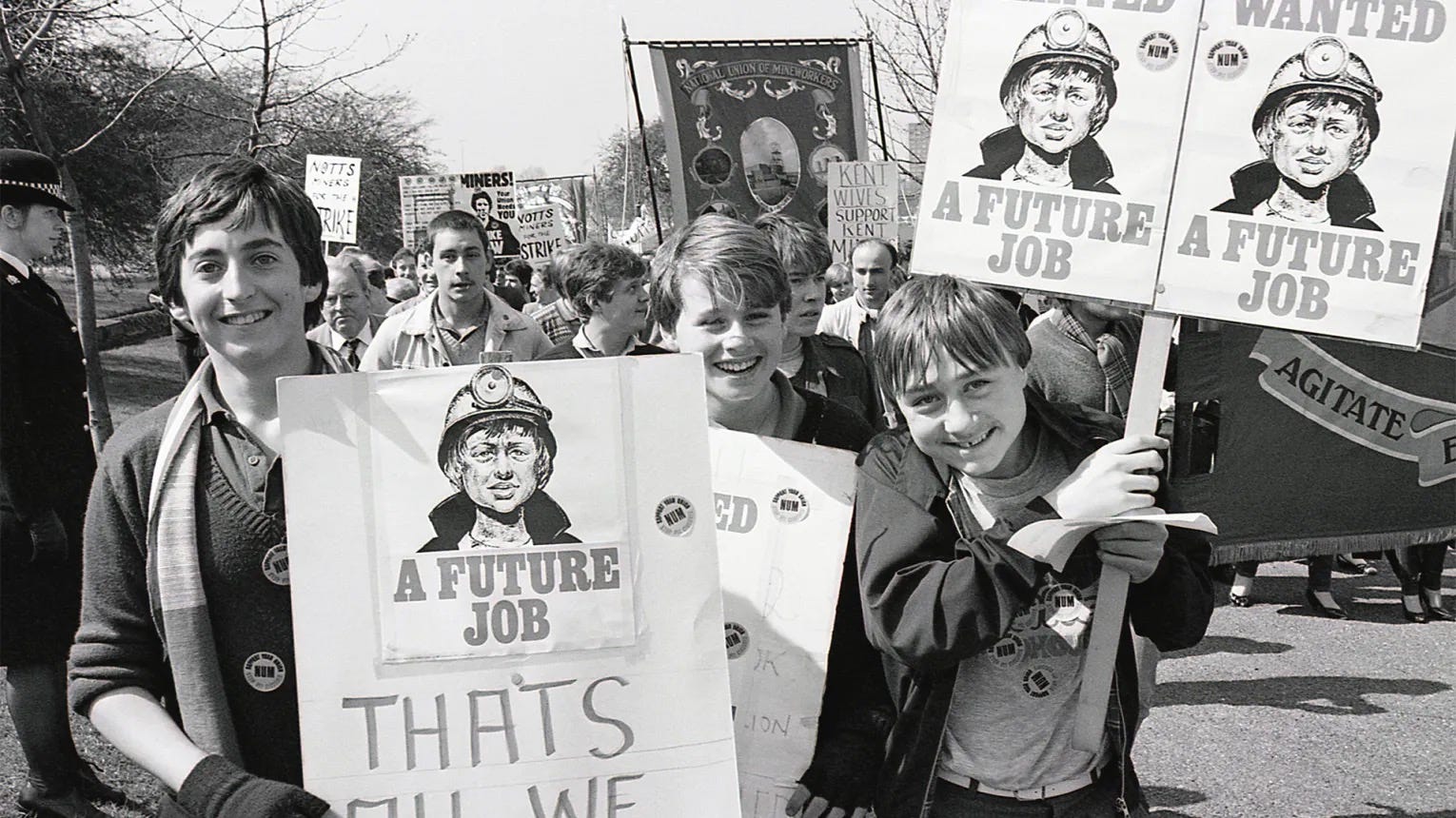
Thatcher’s destruction of mining communities in the 1980s ran the same experiment with white working-class populations.
Pit closures rendered entire regions economically obsolete—not gradually through market forces but deliberately through political decision. Union-busting prevented collective resistance, destroying the organisational infrastructure through which communities might have contested their abandonment.
County Durham, South Yorkshire, South Wales, Central Scotland: regions coded as surplus, their populations managed through mechanisms that capture value from marginality rather than addressing it. Criminalisation intensified precisely as economic opportunities contracted.
Anti-social behaviour orders targeted street-level survival economies. Benefit sanctions penalised joblessness in regions where jobs had been systematically destroyed—between 2010-2020, the DWP imposed over 10 million sanctions, highest rates in former industrial regions. Court fines for minor infractions bled wealth from populations already stripped of wage-earning capacity. In 2019, UK magistrates’ courts imposed £531 million in fines and costs, collection rates lowest in the most economically deprived regions.
The state didn’t abandon these populations—it repurposed them as revenue sources whilst ensuring their economic marginality remained permanent.
By 2023, 14% of UK prison places were privately operated, contracts worth over £4 billion generating consistent returns for G4S and Serco even as rehabilitation outcomes deteriorated. Private probation contracts extracted additional fees from offenders whilst failing to reduce reoffending. Electronic monitoring tracked 13,000 people daily, charging the state £110 million annually whilst creating new markets in human surveillance.
The companies that began managing prisons expanded into asylum detention, electronic monitoring, court security, benefit assessment—diversifying their portfolio of value capture. Not different services but integrated infrastructure operating on populations coded as surplus.
Timeline as Battlefield
The 1984-85 miners’ strike wasn’t just about pit closures—it was about whether working-class communities would control the timeline of their own destruction. The NUM argued for gradual transition allowing communities to adapt.
Capital’s answer: immediate closure, no consultation, police violence against resistance.
Thatcher’s victory established that capital sets the pace. Communities get abandoned on schedules determined by profit calculations, not democratic deliberation.
The rider tried to control her own timeline—work evening to protect Saturday afternoon with her daughter. The algorithm punished her for it.
Capital doesn’t recognise “I have children at home” as valid input. Your time becomes their asset, measured in delivery speeds and acceptance rates.
The miners fought for temporal autonomy. The rider fights for temporal autonomy. Both lose to systems designed to bleed maximum value by controlling when labour is available, when communities can resist, when working-class life gets subordinated to capital’s requirements.
The resulting surplus populations emerged into an economic landscape deliberately structured to prevent their re-absorption into stable employment. New jobs created in former mining regions were predominantly service-sector, part-time, casualised—designed to ensure permanent precarity rather than replace what had been destroyed. Political architecture creating conditions that subsequent systems would monetise.
The gig economy didn’t emerge naturally from technological innovation. It emerged from decades of deliberate precarity creation, spatial concentration of abandonment, destruction of collective bargaining power, and state investment in population management infrastructure. The rider’s algorithmic downranking descends directly from Thatcher’s pit closures—different mechanisms, same logic.
What Managed Precarity Achieves
The system doesn’t need genocide. It needs managed precarity that captures maximum value whilst preventing political organisation.
Carceral systems don’t fail at rehabilitation because they’re poorly designed. They succeed at their actual purpose: transforming human surplus into revenue streams whilst spatially isolating populations that might otherwise organise against the economic abandonment that made them vulnerable to incarceration.
The architecture is self-financing. The same populations positioned as too expensive to employ generate revenue through their managed marginality—court fees, fines, commissary charges, monitoring contracts, private prison returns. Abandonment becomes profitable. Obsolescence becomes asset class.
And because the populations subjected to this are racially marked—in California’s case as Black and Latino, in Britain’s case initially as white working-class but expanding to include racially marked immigrant communities—the draining can be justified through rhetoric about criminality, welfare dependency, burden on resources.
When Sir Jim Ratcliffe claims immigrants are “colonising” Britain whilst his Monaco residency minimises his UK tax contributions, he’s deploying the rhetoric that justifies managing populations as surplus whilst capturing value from their management. The populations being drained get blamed for the draining, whilst the infrastructure extracting value from them generates consistent returns for the oligarch class that owns it.
The rider from Pakistan and the rider from Birmingham experience identical draining—algorithmic downranking, parking fines, Universal Credit surveillance, temporal control preventing them protecting time with their children. Ratcliffe’s rhetoric ensures they see each other as competitors rather than comrades facing unified assault. Fragmentation isn’t side effect; it’s strategy. Divided workers can’t collectively challenge the systems bleeding them.
The actual draining flows upward: from monitored, fined, sanctioned populations toward the oligarch class that profits from their managed precarity whilst lecturing them about burden on the state.
But carceral management is only half the architecture.
Tomorrow: how those same populations get simultaneously enclosed as data sources, their movements and decisions and desperation transformed into behavioural surplus that platforms sell to third parties. The rider isn’t just experiencing fines and sanctions. She’s experiencing digital enclosure that tracks her every movement, packages her hesitations as prediction data, sells her desperation to insurance companies and urban planners.
Two mechanisms, same body, both profiting from her attempt to protect Saturday afternoon with her daughter.
Thanks for the Restack @tiathomson819666
Thanks for the Restack https://substack.com/@anonymous8675309